What Goes Under a Paver Patio, and Why It Matters
The pavers are the part you see. The base is the part that decides whether they stay flat.
October 7, 2026 · 4 min read
Pavers don't hold themselves up
A paver patio looks like a solid surface, but it is really hundreds of separate pieces laid side by side. Each one rests on a thin layer of sand, and that sand sits on a compacted bed of crushed rock. The pavers are the finish. The base underneath is the structure.
That is why two patios that look alike on day one can look very different five years later. One is still flat and tight. The other has a dip by the back door, a high corner near the lawn, and joints that have opened up. Almost every time, the difference is in the work you can't see once the job is done.
Why patios settle and heave
Settling means a section sinks. It happens when the ground under the pavers was soft, loose, or not compacted enough, so it squeezes down under weight and foot traffic. Soil with grass roots and organic matter in it is a common cause. Roots rot, the soil shrinks, and the surface drops.
Heaving is the opposite. A section pushes up. Water gets into the base and the soil below, and when it freezes it expands and lifts whatever is on top. Yakima winters get cold enough for this to matter. A base that drains well gives water somewhere to go, and a patio that slopes slightly away from the house keeps rain from collecting under it.
Here is what a weak base tends to show you over time:
- Low spots where water pools after rain or a sprinkler run.
- Pavers that rock or tilt when you step on them.
- Joints that widen and lose their sand.
- Edges that creep outward onto the lawn or bed.
The dig comes first
A good patio starts by taking ground out, not putting stone down. The sod and topsoil come off, since organic soil will compress and rot. The crew digs down far enough to fit the rock base, the sand layer, and the paver thickness, and still end up at the right finished height. The bottom of that excavation is firmed up and graded to the slope the patio needs.
This is the step that shortcuts like to skip. Laying pavers over lawn or loose dirt is fast, and it looks fine for a season or two. Then the ground underneath starts to move.
A compacted base, built in layers
Crushed rock is spread in layers, and each layer is compacted with a plate compactor before the next goes on. Thin layers compact all the way through. One thick layer only gets tight on top and stays loose underneath. The finished base should feel hard and give very little when you walk on it.
On top goes a thin, even bed of sand, smoothed to the right height. The pavers are set into it in the chosen pattern, cut where they meet edges, and then tapped down level. Fine sand is swept into the joints, and the surface is compacted once more. That last pass locks the pieces together so they act like one surface.
Edge restraint keeps it together
Pavers are held in place by the pavers beside them, and the outer ring has nothing to push against unless something is there. Edge restraint is that something: a firm border along the perimeter, fixed into the ground, that stops the patio from slowly spreading outward. Without it, edges drift, joints open, and corners start to lift.
Abel's & Sons has a job photo of a paver walkway in progress, taken while the edge restraint is still visible along the sides. It is the kind of detail that disappears under soil and grass once the work is finished, and it is a big part of why the walk stays straight.
Block steps need a base too
If the patio sits below the back door or the yard slopes, steps come into the plan. Block steps are heavy, and all that weight lands on a small footprint, so the ground under them needs to be dug out and compacted just like the patio. Each course is set level and tight to the one below, because a small tilt at the bottom shows up as a big one at the top.
The landing where the steps meet the patio matters just as much. If the two settle at different rates, a gap or a lip opens at the joint, and that is a trip hazard.
One of their own jobs
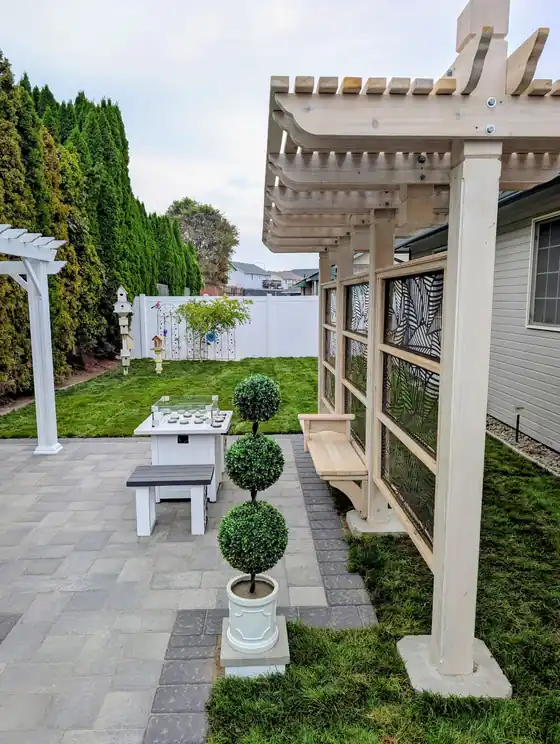
Abel's & Sons shows a before and after of exactly this kind of project in their own photos. The before is a bare dirt backyard with pallets of pavers staged on it. The after is a finished grey paver patio with block steps, next to fresh lawn. Paver patios and retaining walls are part of the work this father-and-sons crew has done for 13 years in Yakima County and the Ellensburg area.
If you have a bare backyard and picture a patio there, call (509) 985-4603 and ask for a free estimate.
Abel's & Sons Lawn Service LLC, (509) 985-4603
Call (509) 985-4603