How to Bring Back an Overgrown Hedge or Arborvitae Row
Cut into the green, keep the face flat, and pick your weather. That is most of the job.
October 7, 2026 · 4 min read
How a hedge gets away from you
A hedge doesn't turn into a problem in one season. It gains a few inches here and a few more there. Then one day the top is out of reach, the sides push into the walk, and the face looks lumpy and loose. Arborvitae rows do the same thing. A row planted as a neat green wall can end up tall, wide, and ragged after a few years without a trim.
Before you cut anything, stand back and look. Is the shrub long and shaggy, with green growth all the way through? Or are there brown, bare patches inside where light no longer reaches? That answer decides how hard you can cut.
Know where the green stops
This is the rule that matters most with arborvitae and most other evergreens. They grow from the green foliage out at the edge. If you cut back into bare brown wood, with no needles on it, that wood usually does not sprout new growth. The bare spot you make tends to stay bare. A bold cut can look fine on the day and leave a hole that never fills in.
So the goal with an overgrown evergreen is to cut back into the green, not past it. Reach into the shrub and find where the live growth ends. Trim to just inside that line. If the plant is so far gone that this won't work, a trim alone won't fix it. It is better to hear that plainly than to ruin the shrub trying.
Cut it flat and square
A good hedge face is flat and square, or tapered so it is a little wider at the bottom than at the top. That slight taper matters. Light has to reach the lower branches, or they thin out and drop their foliage. A hedge cut wider at the top shades itself and ends up green up high and bare down low.
Set your line before you start. A string stretched between two stakes at the height you want gives you something to trim to. Use sharp shears or a hedge trimmer, keep the blade flat against the face, and move in long, even passes. Do the sides first, then the top. Step back often, because a flat top is easiest to judge from a distance.
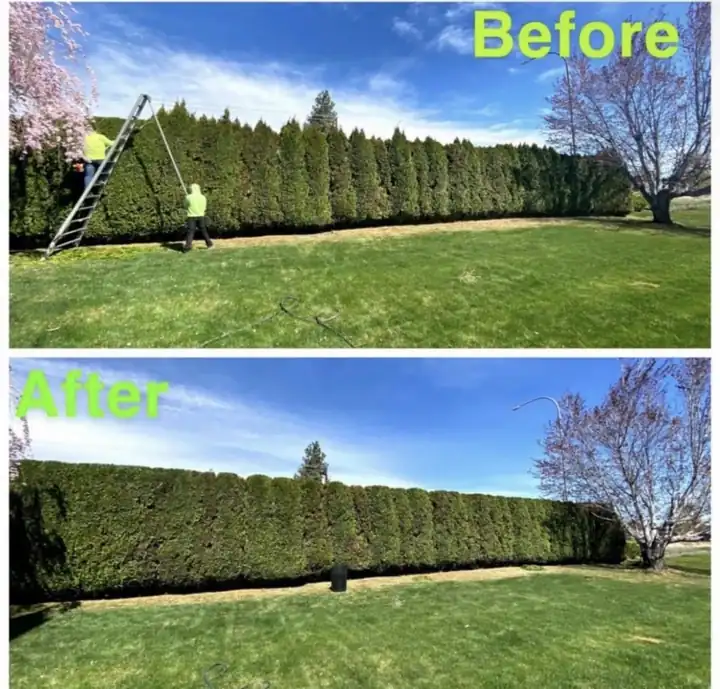
Abel's & Sons has one of these in their own job photos: an overgrown hedge cut back flat, with a worker in a hi-vis shirt beside it. The point of a flat face is that it reads as one clean line from the street, and it makes every later trim quicker.
Tall rows take a ladder
A long arborvitae row is a different job from a short hedge. Once the row is taller than you can reach from the ground, the top has to be shaped from a ladder, and that changes the work. Footing is everything. Soft lawn, sloping ground, and gaps beside a fence all make a ladder unsteady. A careful crew sets it on firm, level ground and moves it often, instead of leaning out to reach one more foot.
Working along the row, the trimmer holds the top at one height and the face in one plane from the first plant to the last. You want the row to look like a single screen, not a line of separate shrubs. Abel's & Sons has a job photo of exactly this: a crew member on a ladder shaping a long arborvitae row.
If your row is well past easy ladder height, think hard before doing it yourself. Falls from ladders are among the most common yard injuries, and trimming means both hands are busy.
Cleanup is part of the trim
Hedge clippings get everywhere. They sit on top of the shrub, drop into the bed below, and stick in the lawn. A finished trim ends with the clippings raked or blown out of the bed, the walk and driveway cleared, and the lawn edge checked. Clippings left piled against the base hold moisture and make the whole job look half done.
Ask who is hauling the debris away. A long row can produce a surprising amount of it, and it is the part homeowners most often forget to plan for.
Timing in a hot, dry climate
Yakima summers are hot and dry, and a freshly cut evergreen has more of its inner foliage exposed to sun and wind. A heavy shearing in the hottest weeks can leave the new face scorched and brown. Light shaping is fine most of the season. Save the big cutback for milder weather, such as spring after the first flush of new growth or early fall when the heat eases.
Water matters too. A dry, stressed shrub takes a hard trim poorly. Give the hedge a deep soak a day or two before and after a heavy cut, and keep the schedule steady through the following weeks.
Getting it done
Bush trimming is part of the regular work at Abel's & Sons Lawn Service, a father-and-sons crew with 13 years of lawn and landscape work in Yakima County and the Ellensburg area. If your hedge or arborvitae row has gotten ahead of you, call (509) 985-4603 and ask for a free estimate.
Abel's & Sons Lawn Service LLC, (509) 985-4603
Call (509) 985-4603